Thursday, August 6, 2015

The Tree Creatures at the Rensing Center

Richard Metz
Pennsylvania
August 2015

The Tree Creatures at the Rensing Center 

The Rensing Center artist residency was a great opportunity for me to explore the nature and culture of Western South Carolina. Or more precisely, to make a connection between the two. My goal was to create a series of tree paintings that explored the idea of “A spirit of the place”. I began the three week residency in July 2015 by having discussions with quite a few people in the community. I asked them to tell me about stories or legends they know about or from the area, different historical events, their personal views of the people of Pickens County where we were, and how the area had changed and their relationship to the land. Different moments that felt meaningful at the residency included:

  1. The loudness of the creatures of the night, crickets, cicadas, bull forge and who knows what else, and their blending of sounds.
  2. The darkness, and the clarity of the night sky. I am pretty sure i saw our galaxy.
  3. Being at the top of a mountain with John F, with him explaining the geology of the area.
  4. Being at Haygood Mill and seeing the machinery of the stream driven mill, seeing a bow maker, chair caning, bobbin pin work and a moonshine still.
  5. Sitting around the bonfire listening to stories with residents and staff.
  6. Seeing the history of the area at the Pickens museum
  7. The drive through the mountains to the Cherokee reservation
  8. Talking with Chad at the Feed store and listening to some of the local people stop by and talk
  9. In a sense, having my outdoor time determined by the weather, i.e, mornings or early evenings for working.
  10. swimming in the lakes
  11. The wonder of the library, which I only barely had time to delve into.
  12. Great discussions with Ellen about sustainability and art, and the challenges and successes now.


I started doing some research about the Cherokee in Philadelphia, looking at some of their beliefs, art work,  history, and stories. While in Pickens, I learned a little about the lives of African Americans through online slave stories, and other web sites focused on life in the early part of the 20th century. I studied the basic history of white people in the area, viewing the great exhibits in the Pickens history museum, focusing on their involvement with native americans, early colonization and slavery, some mid 20th century reading, and discussions about attitudes today.


The works
It was, at times, a bit of struggle to paint for four hours in the heat, with swarms of mosquitos and bees flying around. But a good natural insect repellent was mostly successful in keeping them at bay, and I usually found my joy after about an hour. The Alder Trail is an excellent wooded area and great home for these works as they slowly age away. I kind of jumped around a bit, using images and ideas from all the cultures that have lived in this area. I think I was somewhat successful in creating images

inspired by all these stories and histories, and in that sense, taking cumulatively, as a group, this forest installation can represent a sense, or spirit of
this part of Pickens County, SC.


The multi ethnic man was my initial and perhaps somewhat literal attempt to represent all the cultures, White people of European ancestry, African-Americans, and Native Americans, as represented by skin color, that have been here. So red, pink and brown stripes on a simple running figure.

Wild Hog is a representation of wild hogs that live and roam in the area. Brought in for hunting, they escaped and run free, mucking up farmers patches now and then. I liked the image of a kind of trickster figure.

Isaqueena is the Cherokee legend of the tribeswoman who galloped across the county to warn her English lover, naming all the streams and paths. But the image shows her later in life, jumping into a waterfall,and landing on a ledge, to escape pursuers. I love her bravery and connection to the land.

The Healer is a presentation of a character closest to nature in three different cultures: the Green Man from English history, the shaman from Native American society, and the shaman of African tribal life. One can see the leaves of the Green man, the white face paint of the African tribesman, and the feathers and headband of the Native American. These figures are both documents of my studies, and also an attempt to make an intercultural connection about the possibility of man becoming closer to nature.

Man and Beast is based on an Assyrian sculpture of around 500 BC. I related it to Chad, the farmer who has cows and goats here, so he is dressed like Chad, with blue jeans and a ball cap. I like the idea of interdependence between man and beast, as one way to look at our relationship with animals.
Chad even had a picture of himself with a sheep around his neck (different symbolism) which he forwarded to me. When I was looking for the right tree to paint on ( it needed to be smoother like a Beech), the cows were sitting on the other side of the fence,which allowed me to work the cows head and legs from life. They were great models and we talked a bit.

John and the mountains is a straight forward attempt at creating a meshing of images between John Fritz, a landscape designer who helps out a lot here, and gave us the mountain tour, and an image of the Blue Ridge mountains. It is an attempt to create a figure who is filled with the mountain.


Pan, god of the forests is a depiction of the Greek god of nature, which covers a lot. He is an earlier Pagan religious figure. He is sitting playing his Pan-pipes, on a tree stump in the woods. Lately, I have been thinking of the idea of re-mythologizing or re-enchanting the forest. The woods could be seen as a place of magical beings, a place of mystery and unseen manifestations. of stories and history, and a place with so much spirit that no one would think of tearing it down. A way to connect the environmental necessity of preserving the forests with the human desire for meaning.
The goats on the farm here are always calling out and somewhat inspired this figure as well. I had taken pictures of the goats to study their legs for this image.

The Bow Weevil is a stylized monstrous depiction of the insect that destroyed much of the cotton industry in Pickens in the early part of the 20th century. According to Chad, strict safeguards are now in place to prevent this insect from taking over again, but the amount of cotton produced here is much less, as most farmers switched their fields to grazing cows, goats, sheep and chickens, as well as harvesting timber every 20 years.


Richard Metz

Friday, July 17, 2015

The Treasure Hunt Project: Part I of II

Amelia Blair Langford
Richmond, Virginia
July 2015

The Treasure Hunt Project: Part I of II   

My name is Amelia Blair Langford, 24, from Richmond, VA, US. I am an illustrator with a concentration in ink and graphite studies as well as the creator of "The Treasure Hunt Project" series. I have honorably been an Artist-in-Residence at The Rensing Center for  two of the four weeks I will be here. I have grown to find this place to be a book filled with deep stories, remarkable heritage and passionate history.

May the treasure hunt begin.


Day 1: The Rensing Center is an oasis for reflection, meditation and absolute inspiration. When I arrived, I knew that the Rensing Center was going to be a treasure worth seeking, a shooting star worth watching, and a story waiting to be told.


Day 1: Our first evening together was filled with a delicious potluck with recipes created the farm's gardens and artists in residence evening, social gatherings. And of course, I had to include The Rensing Center's intern, Katie's beautifully, homemade chocolate moose with whipped cream and blueberries.


Day 2: The Rensing Center's pasture is a treasure within itself. It is occupied with goats and cows that are both very social and photogenic. There were new 5-week old babies upon my arrival and it has been a wonderful experience seeing them grow over the past few weeks.


Day 5: We went on a four hour hike and got a nature tour by Jon. The trails, vegetation, wildlife, waterfalls, and of course the views were absolutely breathtaking. We arrived at Glass Mountain in the mid morning and the breeze from atop of the mountain (shown above) was perfect. The treasures that I was looking for, were starting to be discovered.


Day 5: We arrived at Twin Falls mid afternoon. The breeze and cooling mist from the waterfalls were quite a treat. 


Day 7: The luscious sunset cradled the 150 old tree that stands next to the Rensing Center's pasture.


Day 7: We had an evening bonfire with star gazing and storytelling. The stars at The Rensing Center are remarkable and some nights you could even see Venus with the naked eye.


Day 6: My studio and bedroom space is located in the Rensing Center next to the library and I have enjoyed the presence of the animals here, especially Bob the Cat. He was great company while I worked on inking my first "Treasure Hunt Project" piece. 


Day 9 : A part of our contribution in being an Artist in Residence is that we participate in outreach. We got the opportunity to help out on the farm and laid some sod as a team. 


Day 13: I was honorably interviewed and photographed with the work I was completing at the Rensing Center by an Anderson, SC Newspaper. 


I will continue to share my experience with the Rensing Center in Part II in a few weeks where I will share my finalized work I've created for "The Treasure Hunt Project" illustration series. More adventures are to be had and more treasures are to be found.

So far it has been nothing short of extraordinary.

Written by Amelia Blair Langford


Thursday, July 2, 2015

My Time at the Rensing Center by Susan Lenz

Susan Lenz
Columbia, SC
June- July 2015

My Time at the Rensing Center by Susan Lenz

 (Above:  Working the Land. 5" x 16" x 11". Found, rusted pitchfork and fiber vessel.  Click on any image in this blog post to enlarge.)

My name is Susan Lenz.  I'm a fiber and installation artist from Columbia, South Carolina which is only about a two hour drive from the Rensing Center.  I've been fortunate enough to have been accepted to several other residency programs but the Rensing Center was at the top of my list of places to go.  Why? Well, I've known Ellen Kochansky's name for years and years.  Her work is stellar and enjoys respect everywhere.  When I learned that she was embarking on this new program, I wanted to be a part of it.  Plus, what "city girl" couldn't use a couple of weeks to learn more about sustainable practices and good stewardship of the land?  I was very happy when I was scheduled for June 14th through tomorrow, July 3rd!

As a blogger since 2006, I was thrilled to learn that contributing to the Rensing Center blog counted as an hour toward the very reasonable eight hours of weekly work which is done in exchange for the experience.  (One can forgo the work contribution for a small, additional fee.)  Then, I looked at the blog.  Ugh-oh!  Each post seemed to be written so eloquently in poetic words of professional writers giving well phrased testimonials.  I was scared!  I'm not that sort of blogger!  Also, there is no need to "get out of" other work! At the Rensing Center work is actually FUN, social, and leaves one with a strong sense of satisfaction.  Some hours were spent pulling wisteria from the upper garden.  At the end of two hours, three of us got to know Ellen ... as she was pulling wisteria too ... and we had visible results of our labors.  Besides, wisteria is an amazing plant with incredible roots.  One area was particularly overgrown.  I found a rusty pitchfork in the foliage.  Since I found it, Ellen said, "It's yours!"  Happily, I made the most complex fiber vessel to date using a ball of green cording made at the Anderson Center art residency in May.  I'm very pleased with this work.

 (Above:  Detail of Working the Land.)

So, instead of blogging for the Rensing Center during my time, I blogged at Art in Stitches, my blog, and decided to write a recap of my time on this blog during my last few days.  I also decided that I'd write especially for other artists who are considering the program!  In a nutshell, I highly recommend the Rensing Center and here's why:

 
 (Above:  My bedroom in the Main building ... complete with a cat!)

All the bedrooms are basic but have exactly what an artist needs ... a comfortable, clean bed; plenty of drawers and shelves; windows to the world; lots of quietness; a reading lamp; and enough space for all the "stuff" that doesn't go into the studio area.  Shortly after I arrived, an air-conditioner was put into the room as the summer heat was unseasonably high.  It is SO NICE that Ellen and the staff are honestly concerned about their residents being comfortable and able to make their art!

 (Above:  Bob the Cat.)

They were even worried that I might not want Bob the Cat in my room.  Hilarious!  Bob is wonderful and can sleep at the foot of my bed any time!  What a lover!  I wrote a much more detailed blog post called "A Walk Around the Rensing Center" with many images.  Take a look!

 (Above:  Entrance to the Alder Creek trail.)

The blog post also includes photos taken along the Alder Creek trail, a lovely walk in the woods without ever leaving the Rensing Center's property.


Rhododendron were still in bloom ...


... and the waterfall is beautiful.

 (Above:  View to the "wood shop" studio ... which, in my case, became a fiber art space!)

Now ... for the really important stuff!  Here's one side of my studio!  Again, I had more space than I actually needed.  Often I raised the garage door for the feeling of working outside!  This space was only a few steps from my bedroom, the kitchen, and the bathroom.  A few more steps takes one into the well stocked and organized library where there's also a television with Netflix (though I didn't watch anything!).  The entire building is a WiFi zone too.


This is the other side of the studio and by the second week another air-conditioning unit was installed (which supplemented the most powerful fan ever!)  Again, the consideration to making a space comfortable for art was very kind, especially since I really had everything I needed to begin with!

 
 (Above:  One of three blue fiber vessels created at the Rensing Center.)

Although my original proposal called for a focus on these fiber vessels, my actual work was more varied.  This diversion was embraced in the spirit of creativity.  Plus, I spent a couple days just doing "the business of art" ... and that was also okay.  The mission of the Rensing Center is three-fold:  creativity, ecology, and economy.  Thus, working on the entrepreneurial/business side of an art career is another way to spend residency time.  During my stay Ellen was instrumental in sharing her own career in art.  Past contracts, mock ups for corporate clients, and ways in which she organized community based projects were not only shared but readily available in the library.  There is much to learn. 

 
 (Above:  Fourteen works in progress.)

I didn't think I would get around to another idea but somehow I found time to develop a new series for my Atlanta gallery.  The gallerist had given me great critical feedback.  Her words were insightful and let me look at my In Box Series and Stained Glass series in a new way.  At the Rensing Center I had the hours needed to explore a new approach.  For me, working larger and more minimalistic was a challenge but these pieces are all on their way to being successful!  I'm very happy about that!  (I wrote a blog post on this work HERE!)

 
 (Above:  My Babylock Tiara sewing machine and one of four large art quilts, a work in progress.)

Most of my time, however, was spent free motion machine embroidering four large, whole cloth art quilts.  Again, I'm developing an entire new series and this residency was "the gift of time".  Countless hours went into thread painting while thinking about the concepts behind this new work.

 (Above:  The interior of the Hagood Mill.)

Now, every day wasn't entirely spent in my studio!  There were several great field trips.  One Saturday we went to the nearby Hagood Mill to listen to a singer and songwriter performance. We explored all the operational structures.  Docents were weaving, quilting, churning butter, and grinding grains.  There were demonstrations in the blacksmith's forge and moonshine still.  Plus, the music was wonderful!   I wrote another blog post with additional images of the Hagood Mill and the Pickens Flea market among other things.  Check it out HERE.

 
 (Above:  The Pickens Flea Market.)

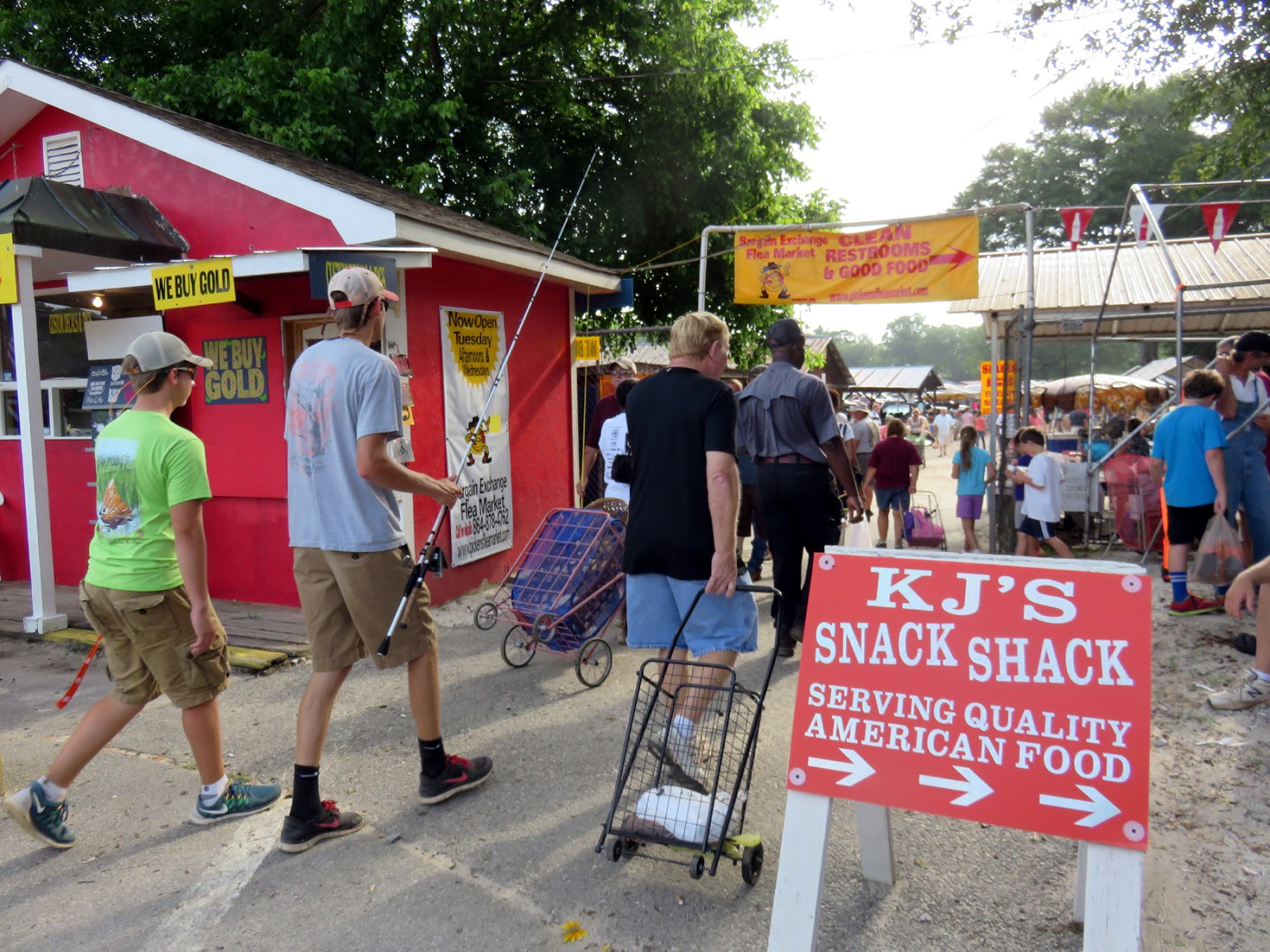
A weekly outing is to the Pickens Flea Market ... which is incredibly large and has an amazing variety of vendors.  One can find a wide variety of produce, vintage records, potted plants, antiques, live chickens, furniture, books, a mobile key shop, and just about everything else ...


... including this really nice man who hauls up extra large shrimp from Edisto!  The Rensing Center bought a couple pound for my 56th birthday on June 24th!  Yes, there's a weekly potluck dinner at Ellen's house!  It is great!  The food, the drink and especially the conversation make this evening special.  To have a birthday at the Rensing Center is a real celebration!

 (Above:  Ellen Kochansky and intern Katie Nocella at the Pickens County dump!)

Another field trip is actually considered an hour toward the weekly work detail.  I went every time just for the fun of it!  It's the Pickens County dump!  Everything gets sorted and the staff is knowledgeable and nice!  It is a great recycling place!  Almost everything can be recycled!

 (Above:  The start of an installation.)

The most exciting "work detail", however, was the opportunity to create an installation needed for an upcoming August wedding.  The upper garden will be the site for the nuptials but it is right beside a steep slope currently being cleared of old pine trees that are now dying and falling down on power lines.  Ellen wanted something to detract from the view of the logging, something organic, something with roots like the wisteria.  She asked me to brainstorm.  I borrowed one of my own ideas, from an installation called I Do / I Don't which is on view at the Bilston Craft Gallery in England ... tying the knot!  Serendipitously, Ellen had miles and miles of ribbon and lace.  We had three different "movie nights", all the residents and staff together ... sitting in the library, watching the screen, tying knots, and earning hours toward our weekly work contribution.  Nothing could have been better than Ellen's thoughtful way of using my talents and skills best.  I would have been happy to "tie the knots" even without it being considered "work".  The photo above was just our start.  By the end of my time, the number of hanging elements easily doubled.


These beautiful streamers of fabric came with stories from the past and many shared memories.  When installed, they will not hang straight down.  The various lengths will be intertwined from one to another, making an ethereal web that will resemble the wisteria roots.  The bride stopped by and really liked it too.

During the three weeks, I got to know Ellen, personally and professionally.  I also got to know the painter and the writer and the intern.  They got to know me.  Everyone worked hard at their own art but we also worked together in the spirit of community.  Every day held a bit of nature too. Whether it was facts and figures on climate change due to the extreme heat during the first two weeks or whether it was about the local soil due to a drain field being dug during my final days or whether it was about the types of goats that thrive in the pasture, every day was in tune with the world around us and how we ought to conduct ourselves in order to live in harmony with nature.


(Above:  Soil quilt block after it was buried for two weeks.)

Such conversations started almost immediately upon my arrival.  I'm happy that I had something to contribute! What?  Well, I brought a 13" square piece of canvas from Hilltop Community Farm in La Valle, Wisconsin.  Erin Schneider, a soil scientist, is spearheading a project called "The Soil Quilt".  She'd been asking farmers to bury a provided piece of canvas in their ground for two to three weeks, allowing the decomposition and soil to mark the fabric.  Each piece is sent back and will become part of a larger quilt.  After all, 2015 is the U.N. International Year of Soil.  I asked if the Rensing Center and me could participate.  The answer was YES. So, Ellen selected a spot in the logging area where I buried our piece of canvas in the red clay ground.  Earlier today, I dug it up  and My final blog post from this residency is about the Soil Quilt.


(Above:  The Rensing Center's contribution to the Soil Quilt.)

This is the result.  For me, it is a perfect way to end this blog post.  It symbolizes the three part mission of the Rensing Center:  Ecology, economic, creativity.

The Rensing Center nourishes creative capability. It fosters individual renewal, community connection, and interdisciplinary interaction among people in artistic, environmental, and entrepreneurial fields.

I am linking this post to Nina-Marie's "Off the Wall Fridays", a site for sharing fiber art work ... and with the hopes that other talented fiber artists submit applications to this fabulous, rural setting in South Carolina to commune with nature, share with an esteemed artist who life has been spent working in our medium, and cherish the "gift of time"!

Thursday, June 4, 2015

Turning a Year Older at the Rensing Center


Lindsay Tigue
Athens, GA
May- June 2015

Turning a Year Older at the Rensing Center


When I reflect on my recent three-week residency at the Rensing Center, I am grateful for the details of the place--the little writer's cabin with its screened-in porch, the desk with the porthole window onto the trees, the little green ceramic mug for my morning coffee, and the Alder Creek trail with its rope down to the falls. I loved greeting the baby goats every morning alongside the soundtrack of their ringing collar bells. I enjoyed the heft of carrying my laundry from one end of the residences to the other to wash and then dry; I counted on my routine of nightly discarding my compost in the bin adjacent to the garden. The later part of my scheduled residency happened to coincide with my thirtieth birthday and I realize how grateful I am to have celebrated it in such a peaceful and enriching environment. People kept calling my birthday a milestone birthday and the term slightly unnerved me, as if the age was supposed to come about alongside its own attendant achievement and success. It can be tempting, of course, to look around on one's birthday and ask, am I doing enough? Being enough? I think, for me, escaping to the shaded and forested hills, the pasture, and the creek; holing up to complete a draft of my book, helped me to focus on the work at hand. It turns out, the details of the place helped the details of my project to appear in focus. I was able to sit and, for hours at a time, read. For hours at a time, I could write. The time and space allowed me to figure things out about my project and to take it in directions I'm not sure I would have otherwise discovered.

My actual birthday was full of wonderful people. The day before, some dear friends made the trek from Athens, Georgia to visit and we sat up on the porch talking late into the night. On the actual day, Ellen, the Rensing Center director, had a lovely potluck for me at her house. The fellow Rensing Center artists-in-residence were there, as were many people associated with the Center. There were cupcakes with chocolate frosting (thanks to Katie the Rensing intern!) and we toasted champagne around a perfect summer bonfire. It's a birthday I will most certainly remember.

During the early days of the residency, I had a slight nagging fear that I wasn't accomplishing enough, but as the days went on, I found a rhythm. When I left, I was so excited about the momentum I'd created. I left ready to continue writing and revising my project. I was more certain of where to head next.  -- Lindsay Tigue

Saturday, May 30, 2015

Rensing Tree

Luna Layla
Fort Worth, TX
May 2015

Rensing Tree


Above is my favorite tree at Rensing.  I gave her a visit today and after saying hello, turned around and headed back the way I came.  A little further down the trail I felt pulled to explore the little nook below.  A shiny glint of something caught my eye (found out later it was the mineral mica), I crouched down by the water's edge to get a closer look and a wonderful thing happened... 

I had one of those rare moments in adulthood when you find yourself doing something you did as a kid, like being hunkered over a stream looking at rocks, and you're getting dirty and it starts to rain but you don't care because you're lost in curiosity.  You are connected to that long-since-used child brain that runs on wonder.  It is such an important thing to be reminded of.  -Layla Luna


Thursday, May 21, 2015

Patterns Reinterpreted from Nature

Kelly Monico
Denver, CO
May 2015

Patterns Reinterpreted from Nature


I was excited to travel to the comfy backwoods of Pickens, South Carolina where I knew I’d have the opportunity to fully immerse myself in my artistic practice at the Rensing Center. This type of immersion is difficult to do with a busy teaching schedule during the academic year. Luckily, I was able to procure ten rich and productive days.

Immediately after arriving at the Rensing Center, I found myself seduced by the captivating scenery and environment. There is a sense of serenity and stillness here that simply isn’t accessible in urban life. The milieu of the Rensing Center, the land, setting, and power of the environment, would be the catalyst for my work over the next 10 days. The peaceful landscape includes twenty some acres of green grass, goats, cows, and a surplus of hundred year old trees. Amidst this vast acreage is a wonderful nature trail that I leisurely hiked several times each day. On my very first hike I began to record and document my environment along the trail. Elements and variables recorded along the path included; trees, slope of trail, leaves, sounds, weather, the creek, temperature, plant life, and flowers. By reinterpreting the information along the trail through patterns, I was able to translate the land into another physical form - creating a hybridity between topography and art. 


The patterned artwork on the left shows documentation that visualizes elements recorded along the nature trail. Every 10 steps are marked with a specific color that designates downhill, uphill, flat, and extreme downhill. The number of rectangular and horizontal shapes in each column represents the amount of trees visible along the edge of the path. The artwork reads from top to bottom, starting with the top left corner of the composition. I’m currently rendering drawings on top of the print that correspond with the amount of leaves and branches fallen along the path. All of this data is recorded in the notes seen left of the artwork.

 ~Kelly Monico | Denver, Colorado 
kellymonico.com/